
‘Too Close to Home’
How a Minneapolis immigrant processes violence, community, and democracy

On the morning of January 24th, Grace was preparing to go grocery shopping ahead of a forecast snowstorm when neighbors began posting urgent messages in community groups: there had been another ICE shooting, this time near a grocery store she frequented.
Grace, a green card holder who moved to Minneapolis from China in 2014, immediately searched online for news but found nothing. Neighbors who rushed to the scene, a 10-minute drive from her home, reported tear gas in the area and urged others to bring masks and goggles if they came.
“I really didn’t have the courage to go,” Grace said. “It felt too close to home.”
Later that day, the victim was identified as Alex Pretti, a Minneapolis ICU nurse who had been trying to help a woman before ICE agents opened fire. Alex’s death came just weeks after Renee Good was killed in a similar incident.
The next morning, Grace noticed the normally calm traffic felt chaotic and aggressive. She wasn’t sure whether the change was real or a result of her own anxiety.

(Photo credit: Grace; Graphic design: Jiahui Tan)
Minnesota Nice
Grace, in her late 30s, and her husband, an American citizen, chose Minnesota for good reasons. They wanted a state that was moderate rather than excessively progressive. Minnesota stood out for being immigrant-friendly, and a place where their two children, who were born in China, could develop independent thinking in what they saw as a neutral, nurturing environment.
Minnesota’s immigrant community is notably larger and more integrated than neighboring states. Nearly 11% of Minnesota’s workforce are immigrants, compared with 7% in Wisconsin, according to the American Immigration Council, an immigration advocacy group.
Grace, a business consultant who had traveled throughout America for study and work, said Minnesota’s welcoming culture stems partly from Scandinavian traditions that emphasize politeness and community solidarity, partly from the state’s engagement with Native American heritage. Years ago, Minneapolis renamed one of its landmark lakes Bde Maka Ska, restoring its original Dakota name to honor the tribe that originally settled there. Grace sees this as reflecting a deeper reckoning with colonization and a commitment to recognizing those who came before. Native American values of treating neighbors as kinship have reinforced Minnesota’s spirit of solidarity, she said.
“The attitude is: you chose Minnesota, that must mean you like it here, so you’re part of us,” Grace said, describing her encounters with longtime residents.
Community Response
In the days following the shooting, Grace’s neighbors gathered quietly, needing each other’s presence even when words failed them.
“I felt like I was facing an unresolvable problem as an ordinary person,” she said. “Helplessness doesn’t quite capture it.”
A few days later at a Chinese buffet, Grace barely knew the owner but asked how she was doing. The question brought the buffet owner to tears. The owner, an immigrant from Fujian province in southeast China, said that with employees and regular customers going into hiding, she had been donating 200 to 250 meals daily to immigrant families for the past three months. She had broken down that morning upon hearing news of another ICE shooting.
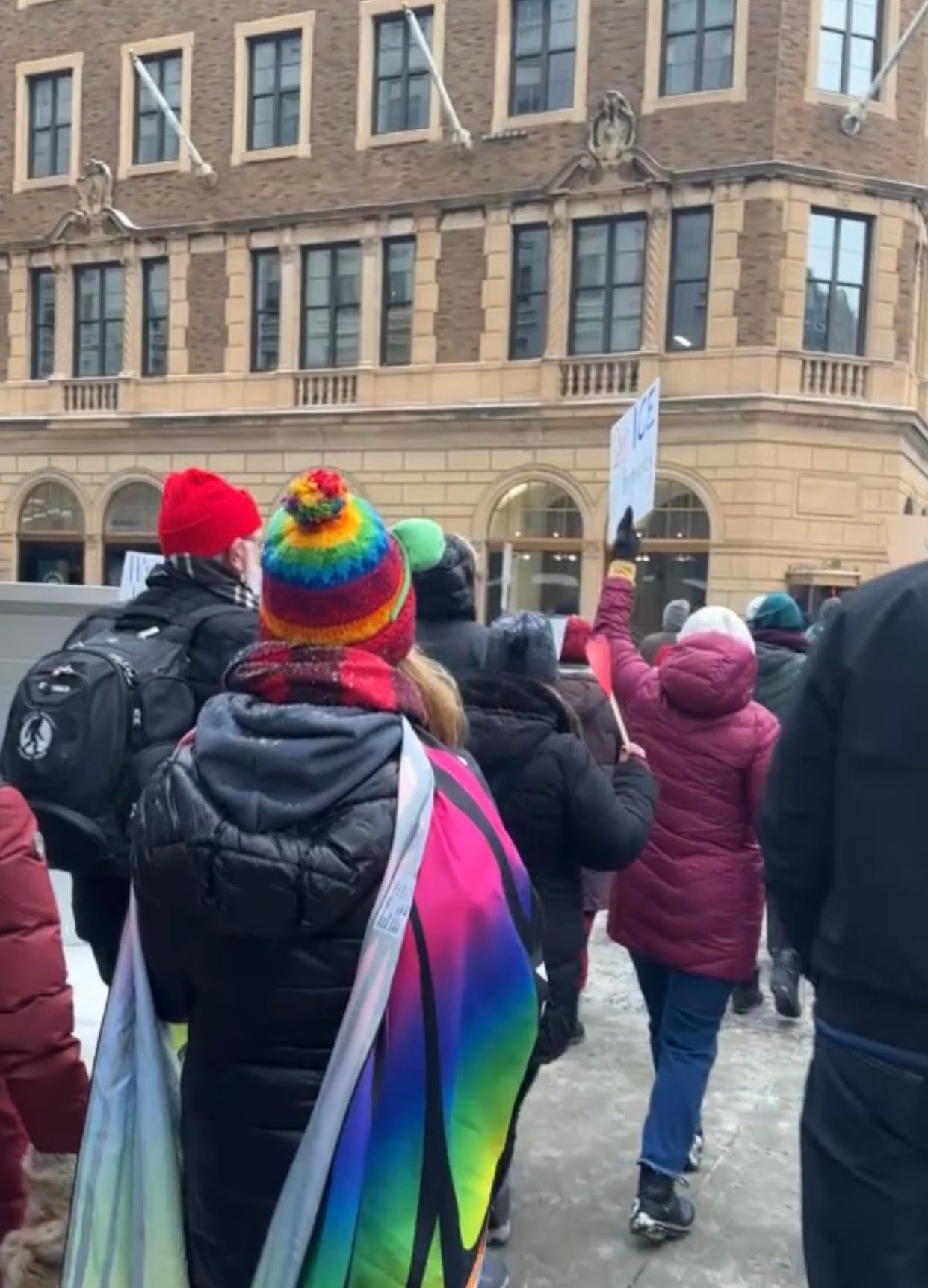
(A peaceful march in Minneapolis; Credit: Grace)
Early in February, Grace joined a peaceful march through downtown Minneapolis. Protesters carried signs reading “humanity” and red paper hearts, singing songs with the line “together we will shine.” The march aimed to encourage ICE agents to stop the violence.
Near the march route, flowers, candles, and photographs of Alex lay covered in snow. Residents paying their respects shared hot chai. “We are ONE,” read one large cardboard sign.
Grace had advocacy experience in China, where she worked on reproductive resources for women. But joining a street protest was a first for her. She said she knew it wouldn't change anyone's mind, but she felt compelled to participate anyway.
A Crack in Decency
The events of January forced Grace to reconsider her understanding of American democracy. She had assumed the system was built on a foundation of shared decency and willingness to compromise for the common good. Now she sees how quickly that foundation can crack.
“What happened in January shows how fragile our peaceful coexistence over the years really was,” she said. “People used to make compromises for the greater good. Now I see how some people decide to react strongly the moment their interests are even slightly affected.”
Her high school-age son, an American citizen, recently asked whether he should carry extra identification documents on a school trip, a question that would have seemed absurd to Grace just months earlier.
Grace said she has been considering returning to China, where she believes there’s greater stability in how communities function and more opportunity for civic engagement at the local level.